By Roberto Gomes, Prime Capital Report | Updated October 2026
For most senior drivers, the best mix of price and service comes from Travelers, State Farm, Geico and Amica. NerdWallet’s October 2026 analysis found Travelers cheapest for 70-year-olds, at a median of $130 a month for full coverage. MoneyGeek’s 2026 senior ranking puts Amica and Travelers on top overall and Geico cheapest at $121 a month. USAA is cheaper still if you are a veteran or in a military family.
Car insurance is cheapest around age 60 and then climbs slowly. In ValuePenguin’s 10-state data, a 75-year-old pays 19% more than a 60-year-old, and rates keep rising into the 80s. Below we compare published 2026 senior rates by company, age and state, explain why prices rise after 70, and list the discounts built for older drivers, with every figure linked to its source.
Key takeaways
- Cheapest for a 70-year-old: Travelers, $130/month for full coverage; Geico and State Farm, $45/month for minimum coverage (NerdWallet, Oct 2026).
- Best overall for seniors: Amica and Travelers tie for MoneyGeek’s top score (4.69/5); Geico is cheapest in that study at $121/month (MoneyGeek, Oct 2026).
- Typical cost: a 70-year-old with good credit and a clean record pays a median of $2,160 a year for full coverage, versus $2,029 at 60 (NerdWallet, Oct 2026).
- Rates rise with age: $158/month at 60, $185 at 75, $203 at 80 and $220 at 85 for women, and slightly more for men (ValuePenguin, June 2026).
- Mature driver course: AARP Smart Driver costs $19.95 for members and $24.95 for non-members; MoneyGeek reports discounts of 5% to 15% at insurers that accept it.
Cheapest car insurance companies for seniors

NerdWallet’s October 2026 analysis uses Quadrant Information Services rates for a 70-year-old driver with good credit and a clean record. These are its national medians for the largest insurers:
| Company | Full coverage (monthly) | Full coverage (annual) | Minimum coverage (monthly) | Minimum coverage (annual) |
|---|---|---|---|---|
| Travelers | $130 | $1,559 | $47 | $564 |
| State Farm | $151 | $1,816 | $45 | $537 |
| Progressive | $157 | $1,881 | $53 | $631 |
| Geico | $172 | $2,067 | $45 | $536 |
| USAA* | $110 | $1,315 | $29 | $344 |
Source: NerdWallet, “Cheapest Car Insurance” (rates refreshed October 2026). *USAA is available only to military families, veterans and some federal employees.
ValuePenguin’s national data for drivers 65 and older (10 most populous states, 2015 Honda Civic EX, full coverage with $500 deductibles) ranks them a little differently:
| Company | Full coverage, drivers 65+ (monthly) |
|---|---|
| State Farm | $162 |
| Travelers | $172 |
| Geico | $183 |
| Progressive | $189 |
| Nationwide | $198 |
| Farmers | $275 |
| Allstate | $282 |
| USAA* | $137 |
Source: ValuePenguin, “How Age Affects Car Insurance Prices for Men and Women” (updated June 30, 2026). *Military families only.
ValuePenguin adds that Farm Bureau had the cheapest full coverage quotes for seniors in its data, at $118 a month, though Farm Bureau options vary by state and require a membership fee. It also recommends comparing Erie, Auto-Owners and Country Financial where they are sold.
Best car insurance for seniors: price plus service
Price isn’t everything at this stage of life. Claims handling, a local agent and coverage options matter more if you are less comfortable with apps or you need help after a crash. MoneyGeek’s 2026 senior ranking scores nine insurers on affordability (50%), customer experience (30%) and coverage options (20%), using Quadrant rates for a senior man with a clean record, good credit, 100/300 liability and a $1,000 deductible.
| Company | MoneyGeek score | Affordability | Customer experience | Coverage | Est. annual cost with bundle |
|---|---|---|---|---|---|
| Amica | 4.69 | 4.84 | 5.00 | 4.24 | $1,400 |
| Travelers | 4.69 | 4.80 | 4.84 | 4.39 | $1,376 |
| Geico | 4.56 | 5.00 | 4.54 | 3.84 | $1,379 |
| Progressive | 4.51 | 4.22 | 4.66 | 4.90 | $1,856 |
| Nationwide | 4.46 | 4.47 | 4.52 | 4.39 | $1,434 |
| State Farm | 4.42 | 4.70 | 4.61 | 3.84 | $1,365 |
| Farmers | 4.31 | 3.85 | 4.42 | 5.00 | $1,929 |
Source: MoneyGeek, “Best Car Insurance for Seniors” (updated Oct. 3, 2026). The last column is MoneyGeek’s estimate after its listed home-auto bundle discount.
What stands out in MoneyGeek’s write-ups:
- Amica earned a perfect 5/5 for customer experience at an average of $130 a month for full coverage.
- Travelers ties Amica overall and offers new-car replacement, gap coverage and a rideshare endorsement.
- Geico is the low-price pick at $121 a month, with an NAIC complaint index of 0.71 (below the 1.00 median) but the lowest coverage score in the group.
- Nationwide has the largest bundle discount in the set (20%), which MoneyGeek estimates cuts a $1,788 annual premium to about $1,434.
- Farmers has the broadest coverage menu but the highest premium, $183 a month.
ValuePenguin’s senior guide adds two named programs worth knowing. Geico’s Prime Time contract, for drivers over 50 who meet certain criteria, guarantees your policy won’t be canceled even if you get multiple tickets. AARP auto insurance from The Hartford includes RecoverCare, which helps pay for things like transportation, cleaning and lawn mowing while you recover from an accident injury, though ValuePenguin warns its prices can rise quickly in your 70s and 80s (ValuePenguin, Sept 30, 2026).
How much is car insurance for seniors by age?
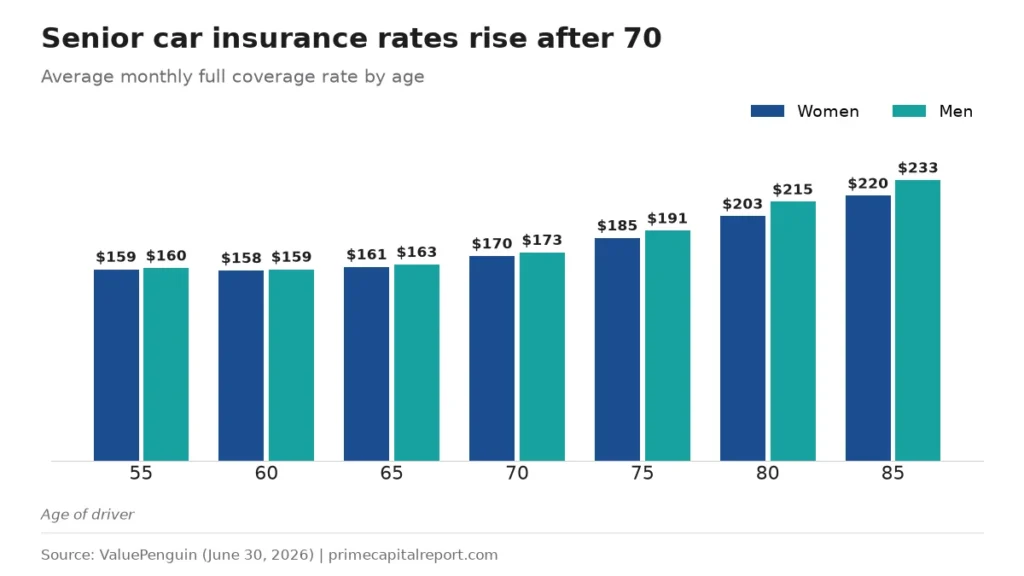
Rates bottom out around 60 and rise gradually after that. ValuePenguin’s 10-state averages for full coverage (good credit, clean record) show the curve:
| Age | Women (monthly) | Men (monthly) |
|---|---|---|
| 55 | $159 | $160 |
| 60 | $158 | $159 |
| 65 | $161 | $163 |
| 70 | $170 | $173 |
| 75 | $185 | $191 |
| 80 | $203 | $215 |
| 85 | $220 | $233 |
Source: ValuePenguin (updated June 30, 2026).
NerdWallet’s national medians show the same pattern at lower absolute levels: $2,029 a year at 60 and $2,160 at 70 for full coverage, and $588 and $658 for minimum coverage (NerdWallet, Oct 2026). MoneyGeek estimates seniors pay $276 more a year than adult drivers nationally.
Florida: a look at 65, 75 and 85
ValuePenguin’s dedicated senior study used quotes from hundreds of Florida ZIP codes, one of the most expensive states and one with a large retired population. Average rates there were $171 a month for full coverage at 65, $194 at 75 and $249 at 85. That’s 13% more at 75 and 46% more at 85 than at 65. Geico was cheapest at $122 a month for full coverage and $64 for minimum coverage, followed by State Farm at $152 and $90.
Best car insurance for seniors by state
The national winner isn’t always the best in your state. MoneyGeek’s 2026 state table names a best-overall provider for seniors in every state. A selection:
| State | Best overall for seniors | Avg. monthly | Avg. annual | Est. annual with bundle |
|---|---|---|---|---|
| Arizona | State Farm | $152 | $1,824 | $1,513 |
| California | State Farm | $156 | $1,872 | $1,554 |
| Florida | USAA | $189 | $2,268 | $2,041 |
| Georgia | State Farm | $158 | $1,896 | $1,574 |
| Illinois | State Farm | $129 | $1,548 | $1,285 |
| Louisiana | State Farm | $198 | $2,376 | $1,972 |
| Michigan | Progressive | $178 | $2,136 | $1,922 |
| New York | State Farm | $178 | $2,136 | $1,773 |
| North Carolina | Erie | $108 | $1,296 | $1,102 |
| Ohio | State Farm | $109 | $1,308 | $1,086 |
| Pennsylvania | Erie | $131 | $1,572 | $1,336 |
| Texas | State Farm | $162 | $1,944 | $1,614 |
Source: MoneyGeek (updated Oct. 3, 2026). Full 50-state list on MoneyGeek’s page.
State Farm is MoneyGeek’s top pick in most states. Maine, Vermont and New Hampshire post the lowest senior premiums nationally in its data. MoneyGeek also notes that California and Massachusetts restrict age as a standalone rating factor, which narrows the differences between insurers there. For more state detail, see our guides to the cheapest car insurance in Texas and the best car insurance in Louisiana.
Seniors with a ticket or an accident
A violation costs seniors less in percentage terms than it costs young drivers, but it still adds up. In ValuePenguin’s Florida senior data, a speeding ticket raised rates by about 9% and an at-fault accident by about 44%.
| Company | After a speeding ticket (monthly, full coverage) | After an at-fault accident (monthly, full coverage) |
|---|---|---|
| Geico | $121 | $188 |
| State Farm | $166 | $180 |
| Travelers | $356 | $340 |
| Allstate | $423 | $373 |
| USAA* | $264 | $676 |
Source: ValuePenguin, “The Best and Cheapest Car Insurance Companies for Seniors” (updated Sept. 30, 2026; Florida drivers aged 65, 75 and 85). *Military families only.
Accident forgiveness is worth pricing if you want to protect a good rate. ValuePenguin points to Progressive’s optional accident forgiveness for seniors worried about a first claim.
Why car insurance costs more after 70
Insurers price on claims experience, and the crash data changes in the 70s. The Insurance Institute for Highway Safety reports that, per mile traveled, fatal crash rates rise noticeably starting at ages 70 to 74 and are highest among drivers 85 and older. IIHS attributes this mostly to greater vulnerability to injury and medical complications, not to a greater tendency to crash. In 2024, 5,679 people aged 70 and older died in motor vehicle crashes; 70% were passenger vehicle occupants and 18% were pedestrians. The per-capita death rate for this group has fallen 47% since 1975 (IIHS, Fatality Facts 2024: Older people, posted June 2026).
IIHS also notes that older drivers are keeping their licenses longer and driving more miles than in the past, which is part of why the cost curve matters to more households each year.
Car insurance discounts for seniors
| Discount | Who qualifies | Published details |
|---|---|---|
| Mature driver / defensive driving course | Usually 55+ | AARP Smart Driver costs $19.95 (members) or $24.95 (non-members); accepted by Geico, Allstate, Nationwide, State Farm and Travelers for 5%–15% (MoneyGeek). AAA RoadWise Driver is free for AAA members. |
| Retiree discount | Safe, retired drivers 55+ | Allstate’s “55 and Retired” discount saves 10% automatically (ValuePenguin) |
| Home-auto bundle | Homeowners, condo owners, renters | 10%–25% range in MoneyGeek’s set; Nationwide 20%, Allstate up to 25% |
| Telematics / low mileage | Retirees who drive less | Snapshot up to 30%, Drivewise up to 40%, SmartRide up to 40%, Drive Safe & Save up to 30% (advertised maximums, MoneyGeek); Nationwide SmartMiles is pay-per-mile (ValuePenguin) |
| Pay in full | Anyone | 5%–10%; monthly billing can add $3–$8 per installment (MoneyGeek) |
| Safety features | Cars with lane-departure warning, cameras, collision-prevention sensors | Offered by many insurers (ValuePenguin) |
Sources: MoneyGeek (Oct 2026); ValuePenguin (June 2026); ValuePenguin (Sept 2026); AARP Driver Safety.
Two practical notes. MoneyGeek says the mature driver discount usually applies at your next renewal, so finish the course at least 30 days before the renewal date. And ValuePenguin points out that State Farm does not offer a specific senior discount, although it does offer discounts for defensive driving courses, safe driving, vehicle safety features and bundling.
Telematics can cut both ways. MoneyGeek notes that Progressive’s Snapshot can raise your rate if your driving scores poorly, so it suits seniors who mostly drive in daylight and avoid hard braking.
How seniors can lower their car insurance
- Re-shop at renewal, especially after 70. The cheapest company changes with age. Get at least three quotes, including one regional insurer. Our guide to comparing car insurance quotes walks through it step by step.
- Tell your insurer you retired. ValuePenguin notes rates don’t drop automatically at retirement, but retirees who stop commuting may qualify for low-mileage discounts or pay-per-mile insurance.
- Take an approved mature driver course and send the certificate to your insurer.
- Review collision and comprehensive on an older car. The Insurance Information Institute’s rule of thumb: if the car is worth less than 10 times the premium, those coverages may not be cost-effective (III).
- Keep liability limits high. Seniors often have savings and home equity to protect. Cut optional extras you don’t use, such as rental reimbursement if you have a second car, before you cut liability.
- Bundle home and auto, but check the bundled price against the cheapest standalone auto quote. MoneyGeek warns a bundle doesn’t help if the base auto rate is too high.
- Pay in full and use autopay to avoid installment fees.
Coverage checklist for senior drivers
Cheaper isn’t better if the policy leaves gaps. Before you switch, check these points on every quote:
- Liability limits. A serious crash can exceed state minimums quickly, and retirees usually have savings and home equity a lawsuit could reach. MoneyGeek’s senior rates are priced at 100/300 liability, a sensible benchmark for comparing quotes.
- Medical payments or PIP. Medicare doesn’t replace every auto-related cost. In no-fault states like Florida and Michigan, personal injury protection rules shape the price, which is one reason MoneyGeek’s state winners differ there.
- Uninsured/underinsured motorist coverage. It pays your own injury costs when the at-fault driver has too little or no insurance.
- Roadside assistance. Useful, but don’t pay twice if you already have it through AAA or a car manufacturer.
- Who else drives the car. If an adult child or caregiver drives you regularly, ask your insurer whether they need to be listed. An undisclosed regular driver can cause trouble at claim time.
- Accident forgiveness and guaranteed renewal. Programs such as Progressive’s accident forgiveness or Geico’s Prime Time contract protect a long-held good rate.
Our methodology
We did not collect our own quotes. We compared published 2026 studies: NerdWallet (Quadrant Information Services data refreshed October 2026; 70-year-old with good credit and a clean record), ValuePenguin’s age study (10 most populous states, 2015 Honda Civic EX, full coverage, updated June 2026) and its Florida senior study (ages 65, 75 and 85, updated September 2026), and MoneyGeek’s senior ranking (nine insurers, Quadrant data, updated October 2026). Studies use different drivers and coverage, so compare companies within a table, not across tables. Crash statistics come from IIHS.
Related guides
- How to Compare Car Insurance Quotes in 2026 (Step-by-Step)
- Cheapest Car Insurance in Texas for 2026
- Best Car Insurance in Chicago (2026)
- Best Car Insurance in Louisiana (2026)
Frequently asked questions
What is the cheapest car insurance for seniors?
In NerdWallet’s October 2026 analysis, Travelers was cheapest for 70-year-olds at $130 a month for full coverage, and Geico and State Farm were cheapest for minimum coverage at $45 a month. MoneyGeek found Geico cheapest at $121 a month. USAA is cheaper still for military families.
What is the best car insurance company for seniors?
MoneyGeek’s 2026 ranking gives Amica and Travelers its top score of 4.69 out of 5, balancing price, customer experience and coverage. State Farm is MoneyGeek’s best-overall pick in most individual states.
At what age does car insurance go up for seniors?
Rates are usually lowest around age 60. ValuePenguin found a 75-year-old pays 19% more than a 60-year-old. In its Florida study, an 85-year-old paid 46% more than a 65-year-old.
How much is car insurance for a 70-year-old?
NerdWallet’s national median for a 70-year-old with good credit and a clean record is $2,160 a year for full coverage and $658 for minimum coverage. ValuePenguin’s 10-state average at 70 is $170 to $173 a month for full coverage.
Do seniors get a discount for a defensive driving course?
Usually, yes. Insurers including Geico, Allstate, Nationwide, State Farm and Travelers accept the AARP Smart Driver course for a mature driver discount of 5% to 15%, according to MoneyGeek. The course costs $19.95 for AARP members and $24.95 for non-members.
Does car insurance go down when you retire?
Not automatically. But if you stop commuting, tell your insurer: you may qualify for a low-mileage discount, a telematics discount or pay-per-mile coverage. Allstate also offers a “55 and Retired” discount of 10% for safe retired drivers.
Does car insurance go up after age 80?
Yes, usually. ValuePenguin’s Florida senior study found an 85-year-old pays 28% more than a 75-year-old. Its 10-state data shows full coverage rising from about $185 to $191 a month at 75 to $203 to $215 at 80.
Is AARP car insurance a good deal?
AARP auto insurance is written by The Hartford and includes extras like RecoverCare after an injury. ValuePenguin warns its prices can rise quickly in your 70s and 80s, so compare it with Travelers, State Farm, Geico and Amica before buying.
Sources
- NerdWallet, “Cheapest Car Insurance,” rates refreshed October 2026: https://www.nerdwallet.com/insurance/auto/cheapest-car-insurance
- NerdWallet, “Average Car Insurance Cost in 2026,” rates refreshed October 2026: https://www.nerdwallet.com/insurance/auto/average-car-insurance-cost
- MoneyGeek, “Best Car Insurance for Seniors,” updated Oct. 3, 2026: https://www.moneygeek.com/insurance/auto/best-car-insurance-for-seniors/
- ValuePenguin, “How Age Affects Car Insurance Prices for Men and Women,” updated June 30, 2026: https://www.valuepenguin.com/how-age-affects-auto-insurance-costs
- ValuePenguin, “The Best and Cheapest Car Insurance Companies for Seniors,” updated Sept. 30, 2026: https://www.valuepenguin.com/senior-car-insurance-how-it-works-and-savings
- Insurance Institute for Highway Safety, “Fatality Facts 2024: Older people,” posted June 2026: https://www.iihs.org/research-areas/fatality-statistics/detail/older-people
- Insurance Information Institute, “How to save money on car insurance”: https://www.iii.org/article/how-to-save-money-on-car-insurance
- AARP Driver Safety, “AARP Smart Driver course”: https://www.aarpdriversafety.org/
Related guides
More guides from Prime Capital Report

Written by
Roberto Gomes, Founder and Editor
Roberto researches insurance and personal finance in the United States and Canada from insurers' policy documents, regulator data and public rate filings. He is not a licensed agent or adviser. How we research.