By Roberto Gomes, Prime Capital Report | Updated October 2026
The best term life insurance companies in the U.S. for 2026 are Banner Life, Guardian, Transamerica, Pacific Life, Nationwide, New York Life and Northwestern Mutual, depending on what you value most. MoneyGeek’s 2026 analysis of 25 insurers names Banner Life best overall, at an average of $37 a month for women and $46 for men at age 40 for a $500,000, 20-year policy. NerdWallet’s October 2026 ranking puts Guardian first, at $26 (women) and $31 (men) for a healthy 40-year-old non-smoker. USAA is a strong pick for military families.
Term life is the cheapest way to buy a large death benefit for the years your family depends on your income. Below we compare published 2026 rates by company, age, coverage amount and smoking status, explain the ratings that matter (AM Best and NAIC complaints), and show how to choose the right term and amount. Every figure is linked to its source.
Key takeaways
- Best overall: Banner Life (MoneyGeek score 4.5/5; A+ AM Best; up to $10 million; terms of 10 to 40 years).
- NerdWallet’s top pick: Guardian, rated 5.0/5, best for applicants with health conditions.
- Typical cost: $47/month for women and $59 for men at age 40 for $500,000 of 20-year coverage (MoneyGeek, Sept 2026). Policygenius puts the average at $26/month for a healthy 40-year-old (cited by NerdWallet).
- Age matters most: the same policy averages $31–$38/month at 30 and $286–$395 at 60 (MoneyGeek).
- Smoking more than triples the price: $148 vs. $47 a month for a 40-year-old woman, and $194 vs. $59 for a man (MoneyGeek).
Best term life insurance companies of 2026
Two of the largest independent rankings use different methods, which is useful: companies that score well in both deserve a closer look.

MoneyGeek’s 2026 rankings
MoneyGeek analyzed thousands of quotes from 25 companies collected in 2026 and weighted affordability (50%), customer experience (30%) and coverage options (20%). Rates below are averages for a 40-year-old non-smoker in average health buying a 20-year, $500,000 policy.
| Best for | Company | Avg. monthly rate (women / men) | Term lengths | Issue ages | AM Best | NAIC complaint index |
|---|---|---|---|---|---|---|
| Overall | Banner Life | $37 / $46 | 10–40 years | 20–75 | A+ | 0.16 |
| Affordability | Transamerica | $37 / $46 | 10–30 years | 18–80 | A | 3.86 |
| No exam | Nationwide | $45 / $56 | 10–30 years | 21–55 | A+ | 0.08 |
| Coverage options | Pacific Life | $38 / $54 | 10–30 years | 18–80 | A+ | 0.05 |
| Seniors | Fidelity Life | $44 / $58 | 10–30 years | 18–70 | A- | 1.66 |
| Term length options | Protective | $42 / $54 | 10–40 years | 18–75 | A+ | 0.21 |
| Customer experience | Mutual of Omaha | $49 / $60 | 10–30 years | 18–80 | A+ | 0.51 |
Source: MoneyGeek, “Best Term Life Insurance Companies (2026)” (updated Sept. 23, 2026). An NAIC complaint index below 1.00 means fewer complaints than expected for the company’s size.
NerdWallet’s 2026 rankings
NerdWallet rates life insurers at the company level, weighting financial strength from AM Best (35%), NAIC consumer complaints (35%), consumer experience (20%) and transparency (10%). Its sample rates are for a healthy, non-smoking 40-year-old buying a $500,000, 20-year policy.
| Best for | Company | NerdWallet rating | Sample monthly rate (women / men) | Term lengths | Coverage / issue ages |
|---|---|---|---|---|---|
| Health conditions | Guardian | 5.0 | $26 / $31 | 1, 10, 15, 20, 30 years | $100,000–$5 million; ages 18–75 |
| Renewable policies | New York Life | 4.9 | $30 / $36 | 1, 10, 15, 20 years | From $100,000; ages 18–75 |
| Military members | USAA | 5.0 | $37 / $32 | 10, 15, 20, 25, 30 years | $100,000–$10 million; ages 18–70 |
| Customer experience | Northwestern Mutual | 4.9 | $38 / $40 | 1, 10, 20 years | From $100,000 or $250,000; ages 18–80 |
| Conversion options | Thrivent | 5.0 | $31 / $37 | 10, 15, 20, 30 years | $100,000–$3 million; ages 18–75 |
Source: NerdWallet, “5 Best Term Life Insurance Companies in 2026” (last updated October 2026). All five carry what NerdWallet calls “exceptional” financial strength, which it defines as A+ or A++ (Superior) from AM Best. Thrivent sells only to people affiliated with the Christian faith.
Company-by-company: what each one does best
- Banner Life: lowest rates in MoneyGeek’s analysis (21% to 22% below its national average), seven term lengths up to 40 years, up to $10 million of coverage and up to $4 million with no medical exam for qualifying applicants. A+ from AM Best; NAIC complaint index 0.16.
- Guardian: NerdWallet’s best life insurer overall for 2026. It extends coverage to some applicants with well-managed conditions, including people living with HIV (ages 20 to 65, on active antiretroviral therapy). Usually requires a medical exam and an agent.
- Transamerica: ties Banner Life on price and accepts applicants up to age 80, with no-exam coverage up to $2 million. The trade-off is service: MoneyGeek lists an NAIC complaint index of 3.86 and a J.D. Power score of 604 (19th).
- Pacific Life: up to $10 million of coverage and $3 million without an exam, plus chronic illness, critical illness and children’s term riders. Its 0.05 complaint index is the lowest in MoneyGeek’s review.
- Nationwide: MoneyGeek’s top no-exam pick, with up to $1.5 million through accelerated underwriting, but only for ages 21 to 55. NAIC complaint index 0.08; J.D. Power 695 (3rd).
- New York Life: offers yearly renewable term (from $250,000) and level term (from $100,000); both can be converted to permanent coverage. Also sells term and guaranteed issue policies for older adults through AARP.
- USAA: available to everyone, with extras for military families. Policyholders aged 18 to 45 can add up to $100,000 of coverage after a birth, marriage or home purchase, and coverage is guaranteed if you leave the military. Some policies are issued by partner companies.
- Northwestern Mutual: one of the lowest complaint rates NerdWallet has seen. Its Term 80 annual renewable policy can last to age 80, though premiums rise every year.
- Mutual of Omaha: ranked first in J.D. Power’s most recent customer satisfaction survey (707, versus a 650 average), according to MoneyGeek, but rates are slightly above average and no-exam coverage tops out at $300,000.
How much does term life insurance cost?
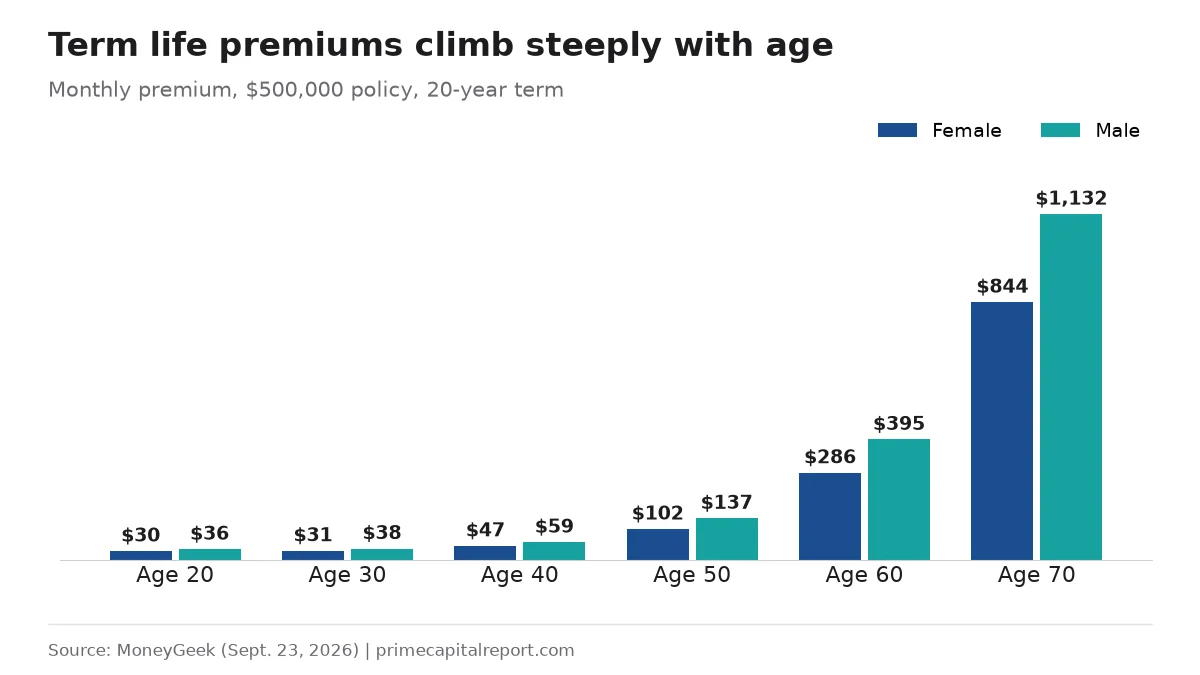
Age, health, smoking status, coverage amount and term length set the price. MoneyGeek’s 2026 averages for a 20-year term, non-smoker in average health:
| Age | Sex | $250,000 | $500,000 | $1 million |
|---|---|---|---|---|
| 20 | Female | $19 | $30 | $51 |
| 20 | Male | $22 | $36 | $64 |
| 30 | Female | $20 | $31 | $54 |
| 30 | Male | $23 | $38 | $67 |
| 40 | Female | $28 | $47 | $86 |
| 40 | Male | $35 | $59 | $109 |
| 50 | Female | $59 | $102 | $194 |
| 50 | Male | $77 | $137 | $262 |
| 60 | Female | $157 | $286 | $545 |
| 60 | Male | $215 | $395 | $771 |
| 70 | Female | $431 | $844 | $1,802 |
| 70 | Male | $558 | $1,132 | $2,586 |
Source: MoneyGeek (updated Sept. 23, 2026). Monthly premiums for a 20-year term.
Two patterns are worth noting. First, doubling coverage from $500,000 to $1 million costs far less than double at younger ages: at 30, a woman pays $54 instead of $31. Second, waiting is expensive: a 40-year-old man pays $59 a month for $500,000, but a 50-year-old pays $137. Buyers at healthier rate classes pay less. NerdWallet cites Policygenius data putting the average at $26 a month for a healthy, non-smoking 40-year-old buying a 20-year, $500,000 policy, which it calls the most common term length and amount sold.
Smokers vs. non-smokers
| 40-year-old, $500,000, 20-year term | Non-smoker (monthly) | Smoker (monthly) | Difference |
|---|---|---|---|
| Female | $47 | $148 | 218% more |
| Male | $59 | $194 | About 229% more (our calculation) |
Source: MoneyGeek (Sept 2026).
Insurers’ tobacco rules differ. MoneyGeek reports several companies offer non-smoker rates after 12 months without nicotine, while Transamerica and Nationwide require two years for the classes in its review.
Term life for older buyers
Choices narrow after 60. MoneyGeek notes maximum application ages among its picks range from 55 (Nationwide) to 80 (Transamerica, Pacific Life and Mutual of Omaha), and most insurers limit terms to 10 years after age 65. It found Fidelity Life cheapest at 70: $132 a month for a woman and $172 for a man for a 10-year, $250,000 policy, though Fidelity has the lowest AM Best rating among its picks (A-).
How to judge an insurer: the ratings that matter
- AM Best financial strength. A term policy may need to pay out 20 or 30 years from now, so the company’s claims-paying ability matters. NerdWallet treats A+ or A++ (Superior) as exceptional; WSJ Buy Side only considers companies rated A or higher for its ranking (WSJ Buy Side).
- NAIC complaint index. Compiled from complaints filed with state regulators. A score of 1.00 is the expected level for a company’s size; lower is better. In MoneyGeek’s data, Pacific Life (0.05) and Nationwide (0.08) score best, Transamerica (3.86) worst.
- J.D. Power satisfaction. Useful for comparing service. Mutual of Omaha led the most recent study cited by MoneyGeek.
- Policy features. Conversion rights, maximum no-exam coverage and available riders differ widely and often matter more than a $3 difference in monthly price.
How term life insurance works
Term life pays a death benefit to your beneficiaries if you die during the term, typically 10 to 30 years. If you outlive the term, coverage ends with no payout. NerdWallet describes it as the most affordable type of life insurance and sufficient for most people, because it covers the years when your financial obligations (a mortgage, tuition, childcare) are highest.
When the term ends, you usually have options. Many policies let you convert to permanent coverage without a new medical exam, usually at a higher premium; Thrivent, for example, allows conversion without an exam during the first five years. Others let you renew year by year at rising prices. Common riders include waiver of premium, accelerated death benefit (paying part of the benefit early if you are terminally ill) and children’s term coverage.
Choosing a term length and amount
- Match the term to your longest obligation. MoneyGeek notes shorter terms suit temporary debts like a loan or the last years of a mortgage, while 20- and 30-year terms are common for protecting income while raising children. Banner Life and Protective offer 35- and 40-year terms.
- Size the benefit to replace income and clear debts. Add up the mortgage balance, other debts, future education costs and several years of income your family would need, then subtract savings and any workplace coverage.
- Don’t rely only on workplace coverage. LIMRA’s 2026 Facts About Life Insurance says nearly half (47%) of Americans with life insurance have coverage through work. Group coverage usually ends if you leave the job.
The coverage gap in the U.S.
According to the 2026 Insurance Barometer Study by LIMRA and Life Happens, 52% of American adults say they have life insurance, and 38%, about 92 million adults, say they need it or need more. Only 29% say they would stay financially secure for more than two years if a primary wage earner died, and 47% say they would have trouble paying living expenses within six months (LIMRA, 2026 Facts About Life Insurance). The top two reasons people give for not buying are that they think it’s too expensive and that they have other financial priorities.
Term sales are growing as buying moves online. LIMRA reports term new annualized premium rose 6% to $824 million in the second quarter of 2026, with policy count up 5%, and credits online distributors and digital term platforms for the largest gains. Term was about 17% of the individual life market by premium (LIMRA, Aug. 26, 2026).
How to get the cheapest term life insurance
- Buy sooner rather than later. Every decade adds substantially to the price in MoneyGeek’s table.
- Compare at least three insurers, including Banner Life, Guardian or Pacific Life and one no-exam option such as Nationwide, if you qualify.
- Quit nicotine before applying if you can. Most insurers need 12 months nicotine-free, and some need two years, for non-smoker rates.
- Consider a medical exam. No-exam policies are faster, but fully underwritten policies can price healthy applicants into better classes.
- Use “laddering.” Two smaller policies with different terms (for example, a 30-year and a 15-year) can cost less than one large long policy if your needs fall over time.
- Pay annually if the insurer offers a discount for it.
- Disclose everything honestly. Misstatements can lead to a denied claim.
Our methodology
We did not collect our own quotes. Company rankings and rates come from MoneyGeek’s 2026 term life study (25 companies, 40-year-old non-smoker in average health, updated September 23, 2026) and NerdWallet’s 2026 term life rankings (healthy 40-year-old non-smoker, updated October 2026). AM Best ratings, NAIC complaint indexes and J.D. Power scores are as reported by MoneyGeek. Market statistics come from LIMRA. Rates are illustrative; your price depends on your health, history and the insurer’s underwriting. Canadian readers should see our term life insurance in Canada guide.
Related guides
- Term Life Insurance in Canada 2026: 10 vs 20 vs 30-Year Terms, Costs and How to Choose
- Life Insurance in Canada 2026: Costs, Types and How to Buy
- Life Insurance vs Mortgage Insurance: Which Protects Your Family Better?
- Critical Illness Insurance: Costs, Coverage and the Fine Print
Frequently asked questions
Which company has the best term life insurance in 2026?
MoneyGeek ranks Banner Life best overall for its low rates, terms up to 40 years and coverage up to $10 million. NerdWallet ranks Guardian first, rating it 5.0 out of 5 for financial strength, low complaints and coverage for some health conditions.
How much is a $500,000 term life policy?
MoneyGeek’s 2026 averages for a 20-year, $500,000 policy are $31 to $38 a month at age 30, $47 to $59 at 40 and $102 to $137 at 50 for non-smokers in average health. NerdWallet’s healthy 40-year-old sample rates run from $26 to $40 a month at its top-rated insurers.
Who has the cheapest term life insurance?
In MoneyGeek’s 2026 analysis, Banner Life and Transamerica tied for the lowest rates at $37 a month for women and $46 for men at age 40. Banner Life has a much lower NAIC complaint index (0.16 versus 3.86).
What AM Best rating should a life insurer have?
Look for A or higher. NerdWallet treats A+ and A++ (Superior) as exceptional financial strength, and WSJ Buy Side only includes insurers rated A or higher in its term life ranking.
Can I get term life insurance without a medical exam?
Yes, if you qualify. MoneyGeek lists no-exam limits of up to $4 million at Banner Life, $3 million at Pacific Life, $2 million at Transamerica and $1.5 million at Nationwide.
How much more do smokers pay for term life insurance?
More than three times as much in MoneyGeek’s data: a 40-year-old woman pays $148 a month as a smoker versus $47 as a non-smoker for $500,000 of 20-year coverage, and a man $194 versus $59.
What happens when my term life policy expires?
Coverage ends with no payout. Depending on the policy, you may be able to convert to permanent insurance without a new exam, renew annually at higher rates, or buy a new policy based on your age and health at that time.
How many Americans have life insurance?
About 52% of American adults say they have some life insurance, according to LIMRA and Life Happens’ 2026 Insurance Barometer Study. About 92 million adults say they need coverage or need more.
Sources
- MoneyGeek, “Best Term Life Insurance Companies (2026),” updated Sept. 23, 2026: https://www.moneygeek.com/insurance/life/best/term/
- NerdWallet, “5 Best Term Life Insurance Companies in 2026,” last updated October 2026: https://www.nerdwallet.com/insurance/life/best-term-life-insurance
- LIMRA and Life Happens, “2026 Facts About Life Insurance” (2026 Insurance Barometer Study): https://www.limra.com/siteassets/newsroom/liam/2026/facts-about-life-insurance.pdf
- LIMRA, “U.S. Individual Life Insurance Sales Continue Growth Trend in the Second Quarter,” Aug. 26, 2026: https://www.limra.com/en/newsroom/news-releases/2026/limra-u.s.-individual-life-insurance-sales-continue-growth-trend-in-the-second-quarter-led-by-whole-life-and-vul
- WSJ Buy Side, “Best Term Life Insurance Companies of 2026” (methodology), May 11, 2026: https://www.wsj.com/buyside/personal-finance/life-insurance/best-term-life-insurance
Related guides
More guides from Prime Capital Report

Written by
Roberto Gomes, Founder and Editor
Roberto researches insurance and personal finance in the United States and Canada from insurers' policy documents, regulator data and public rate filings. He is not a licensed agent or adviser. How we research.
Pingback: How Much Does a Speeding Ticket Raise Car Insurance? (2026)