By Roberto Gomes, Prime Capital Report | Updated October 2026
A DUI raises car insurance by roughly 75% to 90% on average, and the cheapest large insurers afterward are usually Travelers, Progressive and State Farm. NerdWallet’s October 2026 analysis found full coverage rising from a median of $2,361 to $4,437 a year after one DUI (88%), with Travelers cheapest at $232 a month. ValuePenguin found the same 88% average increase, and NJM, Erie and Progressive among the cheapest companies.
The penalty usually lasts three to five years, and in most states you will also need an SR-22 or FR-44 filing. Below we compare published 2026 DUI rates by company, state and age, show how long the surcharge lasts, and lay out the steps that bring the price down fastest. Every figure is linked to its source.
Key takeaways
- Average increase: 88% for full coverage, from $2,361 to $4,437 a year (NerdWallet, Oct 2026). LendingTree’s state-by-state study puts the average at 74.5% (June 2026).
- Cheapest large insurers after a DUI: Travelers $232/month, Progressive $260, State Farm $262 (NerdWallet, Oct 2026).
- Smallest increases: Progressive (+29%) and NJM (+33%); the largest were State Farm (+144%) and Geico (+136%) in ValuePenguin’s data (June 2026).
- By state: North Carolina has the steepest increase in both ValuePenguin’s (+303%) and LendingTree’s (+284.1%) data. Michigan is the most expensive state after a DUI at $670/month (ValuePenguin).
- How long: ValuePenguin’s average rate stays near $285–$291 for two years, falls to $205 after three years and $187 after five.
How much does car insurance go up after a DUI?
The three largest national studies agree on the scale of the increase, even though they use different drivers:
| Study | Before DUI (annual) | After one DUI (annual) | Increase |
|---|---|---|---|
| NerdWallet, full coverage (Oct 2026) | $2,361 | $4,437 | 88% (+$2,076) |
| NerdWallet, minimum coverage (Oct 2026) | $648 | $1,231 | 90% |
| ValuePenguin, full coverage (June 2026) | $2,172 ($181/mo) | $4,692 ($391/mo) | 88% (+$183/mo) |
| LendingTree, state average (June 2026) | $2,130 | $3,716 | 74.5% (+$1,585) |
Sources: NerdWallet, Average Car Insurance Cost in 2026; ValuePenguin, How Does a DUI Affect Your Auto Insurance Rates (updated June 30, 2026); LendingTree DUI rates study (June 22, 2026). We multiplied ValuePenguin’s monthly averages by 12 for the annual column; the minimum-coverage percentage is our calculation from NerdWallet’s figures.
LendingTree estimates the increase adds up to $4,755 over three years. That figure leaves out court fines, legal fees and any ignition interlock costs. The National Highway Traffic Safety Administration says a first offense can cost a driver upwards of $10,000 in fines and legal fees (NHTSA).
Cheapest car insurance companies after a DUI

NerdWallet’s October 2026 national medians are for a driver with good credit and one recent DUI:
| Company | Full coverage (monthly) | Full coverage (annual) | Minimum coverage (monthly) | Minimum coverage (annual) |
|---|---|---|---|---|
| Travelers | $232 | $2,783 | $71 | $853 |
| Progressive | $260 | $3,122 | $71 | $855 |
| State Farm | $262 | $3,147 | $84 | $1,014 |
| American Family | $308 | $3,690 | $93 | $1,120 |
| USAA* | $255 | $3,056 | n/a | n/a |
Source: NerdWallet, “Cheapest Car Insurance” (rates refreshed October 2026). *USAA is available only to military families, veterans and some federal employees.
Which insurers raise rates the least?
ValuePenguin’s data, from quotes in every U.S. ZIP code for a 30-year-old man with a 2018 Honda Civic, shows both the post-DUI price and the percentage increase at each company. The two don’t always line up.
| Company | Full coverage after a DUI (monthly) | Increase vs. clean record |
|---|---|---|
| USAA* | $125 | 98% |
| Erie | $154 | 66% |
| NJM | $168 | 33% |
| Shelter | $192 | 45% |
| Progressive | $207 | 29% |
| Travelers | $289 | 67% |
| American Family | $296 | 86% |
| Mercury | $332 | 52% |
| Auto-Owners | $346 | 102% |
| Allstate | $435 | 54% |
| Geico | $441 | 136% |
| State Farm | $469 | 144% |
| Farmers | $494 | 69% |
| Nationwide | $594 | 124% |
Source: ValuePenguin (updated June 30, 2026). *Military families only. NJM and Erie are regional insurers.
Two lessons stand out. First, Geico and State Farm are cheap for clean-record drivers but raise rates sharply after a DUI in ValuePenguin’s data, so staying put may cost you. Second, results vary by study: MoneyGeek’s 2026 analysis (529,578 quotes from 67 companies, 40-year-old driver) found State Farm cheapest after a DUI at $192 a month, ahead of Travelers ($236), National General ($249) and Progressive ($251), with Geico at $334 (MoneyGeek, updated May 20, 2026). The only reliable way to know is to quote several of them.
Car insurance after a DUI by state
State law, court practice and insurer competition make the DUI penalty very different from one state to the next. ValuePenguin’s state averages for full coverage after one DUI:
| State | Full coverage after a DUI (monthly) | Increase |
|---|---|---|
| California | $620 | 181% |
| Florida | $521 | 68% |
| Georgia | $423 | 130% |
| Illinois | $337 | 82% |
| Louisiana | $508 | 55% |
| Michigan | $670 | 158% |
| New Jersey | $448 | 80% |
| New York | $394 | 74% |
| North Carolina | $592 | 303% |
| Ohio | $268 | 81% |
| Pennsylvania | $340 | 72% |
| Texas | $399 | 62% |
| Washington | $329 | 50% |
Source: ValuePenguin (updated June 30, 2026). All 50 states and D.C. are on ValuePenguin’s page.
According to ValuePenguin, a single DUI more than doubles the price of car insurance in eleven states: California, Georgia, Hawaii, Maine, Maryland, Michigan, Minnesota, Mississippi, Rhode Island, South Dakota and Vermont.
LendingTree’s June 2026 study, built on a different sample, ranks the steepest percentage jumps as North Carolina (+284.1%, from $1,208 to $4,640 a year), California (+136.0%, from $2,600 to $6,135) and Delaware (+124.0%). It found the smallest jumps in Mississippi (+17.4%), New York (+28.7%) and Maryland (+35.4%). Rates differ because the studies’ sample drivers differ, but the high- and low-penalty states are broadly consistent. For Texas-specific numbers, see our guide to the cheapest car insurance in Texas, which includes a DUI section.
Car insurance after a DUI by age
Young drivers pay the most after a DUI because they start from a higher base. NerdWallet’s 20-year-old with one DUI pays a median of $7,892 a year for full coverage, against $4,722 with a clean record (NerdWallet, Oct 2026). LendingTree found 20-year-olds pay an average of $2,532 more a year after a DUI and 80-year-olds $2,211 more.
| Age group | Cheapest after a DUI | Monthly | Next cheapest |
|---|---|---|---|
| Young drivers | State Farm | $293 | National General $353; Travelers $362 |
| Adults | State Farm | $133 | Travelers $144; Progressive $144 |
| Seniors | State Farm | $150 | Progressive $186; Travelers $201 |
Source: MoneyGeek, “Best Cheap Car Insurance After a DUI” (updated May 20, 2026). MoneyGeek’s age-group averages after a DUI are $500/month for young drivers, $203 for adults and $253 for seniors.
ValuePenguin adds that a 21-year-old with a DUI pays about 40% more than an older driver with a DUI, and that the number of offenses compounds quickly: its 30-year-old pays $292 a month with one DUI, $363 with two and $454 with three.
Cheapest insurers for a DUI with an SR-22 filing
The cheapest company for a DUI isn’t always the cheapest once an SR-22 filing is added. MoneyGeek priced DUI drivers who also need an SR-22 and found a different order from its general DUI ranking:
| Company | DUI + SR-22 (monthly) | DUI + SR-22 (annual) |
|---|---|---|
| American Family | $198 | $2,381 |
| Geico | $227 | $2,723 |
| Travelers | $228 | $2,736 |
| Progressive | $231 | $2,770 |
| Auto-Owners | $242 | $2,904 |
| State Farm | $262 | $3,144 |
| Allstate | $355 | $4,262 |
Source: MoneyGeek (updated May 20, 2026).
State Farm, MoneyGeek’s cheapest pick for a DUI alone, ranks sixth here. If your state requires a filing, make sure every quote you collect includes it.
Military and veteran drivers. MoneyGeek’s military-profile data shows State Farm with the lowest full coverage rate after a DUI ($1,231 a year) and USAA close behind ($1,258), with USAA cheapest for minimum coverage at $522 a year. If you qualify for USAA, always include it in your comparison.
How long does a DUI affect car insurance?
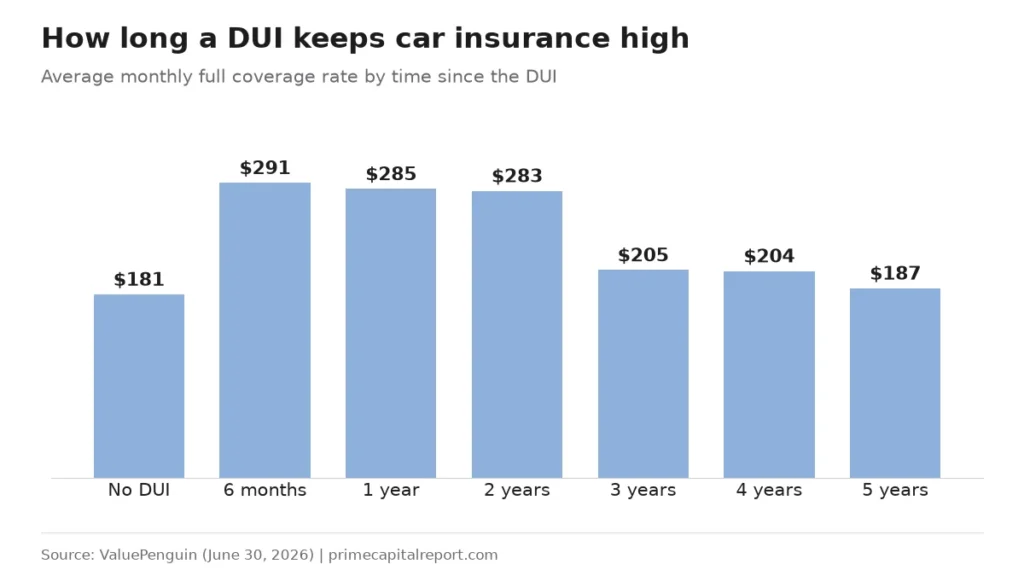
Most insurers look back three to five years when setting rates. ValuePenguin tracked how the average full coverage rate for its sample driver changes over time:
| Time since DUI | Average monthly rate (full coverage) |
|---|---|
| No DUI | $181 |
| 6 months | $291 |
| 1 year | $285 |
| 2 years | $283 |
| 3 years | $205 |
| 4 years | $204 |
| 5 years | $187 |
Source: ValuePenguin (updated June 30, 2026).
The big drop comes at the three-year mark. ValuePenguin notes that a DUI can stay on your driving record for five to 10 years or longer, but it likely won’t affect your rates for that long. MoneyGeek adds that in some states a DUI stays on your record for life. Mark your calendar for the third anniversary of the conviction and re-shop then.
How DUI insurance works: SR-22, FR-44 and disclosure
- Your insurer will find out. ValuePenguin says the DMV notifies insurers of DUI, DWI and DWAI convictions and license suspensions, and insurers check your record at renewal. Hiding it won’t stop the increase and may get your policy canceled.
- The increase usually starts at renewal, not mid-policy. That gives you time to compare quotes before the new rate takes effect.
- You will probably need an SR-22 (or FR-44). This certificate, filed by your insurer, proves you carry the required coverage. ValuePenguin says filing fees are typically about $15 to $50 and you may need to keep it for three to five years. Florida and Virginia use the FR-44 after a DUI, which requires higher liability limits: 100/300/50 for three years from reinstatement in Florida (FLHSMV) and double the SR-22 minimums in Virginia (Virginia DMV).
- Some insurers won’t file. If yours drops you or won’t file, you may need a non-standard (high-risk) insurer, which usually charges more. States also run residual-market plans as a last resort; in Texas, for example, drivers turned down by two companies can get basic coverage through TAIPA, as our Texas guide explains.
- Ignition interlock. NHTSA notes many states require offenders to install an ignition interlock device at their own expense. Your car won’t start unless your breath test is below a preset limit, usually .02 g/dL.
- DUI accidents are still covered. ValuePenguin confirms your policy pays for damage or injuries you cause up to your limits, even if you were impaired. But a DUI crash raises rates even more than a DUI alone.
Why insurers treat a DUI so seriously
Insurers price on claims risk, and impaired driving is strongly linked to serious crashes. NHTSA reports that 11,904 people died in drunk-driving crashes in 2024, about one every 44 minutes, and that about 30% of all U.S. traffic deaths involve a driver at .08 BAC or higher. Drivers at a .08 BAC are about four times more likely to crash than sober drivers, and at .15 at least 12 times more likely. Drivers with a BAC of .08 or more involved in fatal crashes were three times more likely to have a prior impaired-driving conviction (NHTSA, Drunk Driving). That repeat-offense pattern is why insurers surcharge a DUI for years, not months.
How to get cheaper car insurance after a DUI
- Shop before your renewal. The gap between companies is enormous: $326 a month between Progressive and Nationwide in ValuePenguin’s data. Quote Travelers, Progressive and State Farm, plus a regional insurer such as Erie, NJM, Shelter or your state’s Farm Bureau. Our guide to comparing car insurance quotes explains how to keep quotes comparable.
- Ask each insurer whether it files SR-22s in your state and what it charges.
- Adjust coverage on older cars. MoneyGeek’s DUI data ranges from $2,104 a year for state-minimum liability to $4,168 for 100/300/100 full coverage with a $1,000 deductible. Drop collision only if you could replace the car yourself, and never go below what a lender requires.
- Raise your deductible if you have emergency savings to cover it.
- Complete court-ordered programs and keep proof. A completed program won’t erase the conviction, but it keeps your license valid and avoids a lapse in coverage, which raises rates further.
- Never let coverage lapse. If your SR-22 policy cancels, the insurer notifies the state and your license can be suspended again.
- Try telematics once your insurer allows it. A good driving score can earn back part of the surcharge at some companies.
- Re-shop at three and five years. Those are the points where ValuePenguin’s average rates fall most.
Our methodology
We did not collect our own quotes. We compared published 2026 studies from NerdWallet (Quadrant Information Services data, refreshed October 2026), ValuePenguin (quotes from every U.S. ZIP code for a 30-year-old man with a 2018 Honda Civic, updated June 2026), MoneyGeek (529,578 quotes from 67 companies, 40-year-old man with a 2012 Toyota Camry, updated May 2026) and LendingTree’s state DUI study (June 2026). Safety data comes from NHTSA. Because each study uses a different driver and coverage, compare companies within a table rather than across tables.
Related guides
- How to Compare Car Insurance Quotes in 2026 (Step-by-Step)
- Cheapest Car Insurance in Texas for 2026
- Best Car Insurance in Louisiana (2026)
- Best Car Insurance in Chicago (2026)
Frequently asked questions
How much does car insurance go up after a DUI?
About 88% on average for full coverage, according to both NerdWallet and ValuePenguin in 2026. NerdWallet’s median rises from $2,361 to $4,437 a year. LendingTree’s state-by-state average increase is 74.5%.
Who has the cheapest car insurance after a DUI?
Among large national insurers, NerdWallet found Travelers cheapest at $232 a month for full coverage, followed by Progressive ($260) and State Farm ($262). MoneyGeek found State Farm cheapest at $192. Regional insurers like NJM and Erie were cheaper still in ValuePenguin’s data.
How long does a DUI stay on your insurance?
Usually three to five years. ValuePenguin’s average rate stays elevated for about two years, then drops sharply at three years and nearly returns to normal by five. The conviction itself can stay on your driving record for five to 10 years or longer.
Do I need SR-22 insurance after a DUI?
In most states, yes. Your insurer files the SR-22 certificate with the state, typically for a fee of about $15 to $50, and you usually must keep it for three to five years. Florida and Virginia use a similar form called the FR-44 with higher required limits.
Will my insurance company find out about my DUI?
Yes. The DMV notifies insurers of convictions and suspensions, and insurers check your driving record at renewal. Not disclosing it won’t prevent the increase and can lead to cancellation.
Which state has the highest car insurance after a DUI?
ValuePenguin found Michigan most expensive at $670 a month for full coverage after a DUI, with California at $620. North Carolina has the steepest percentage increase in both ValuePenguin’s (303%) and LendingTree’s (284.1%) data.
Does car insurance cover an accident if I was driving drunk?
Your liability coverage still pays for damage and injuries you cause, up to your limits. But you face criminal penalties, and a DUI accident raises your premium more than a DUI alone.
How much is minimum coverage after a DUI?
NerdWallet’s October 2026 median for minimum coverage after one DUI is $1,231 a year, versus $648 with a clean record. Travelers and Progressive were cheapest at about $71 a month. Minimum coverage won’t pay to fix your own car, so it fits best if your car is older and paid off.
Sources
- NerdWallet, “Average Car Insurance Cost in 2026,” rates refreshed October 2026: https://www.nerdwallet.com/insurance/auto/average-car-insurance-cost
- NerdWallet, “Cheapest Car Insurance,” rates refreshed October 2026: https://www.nerdwallet.com/insurance/auto/cheapest-car-insurance
- ValuePenguin, “How Does a DUI Affect Your Auto Insurance Rates in 2026?,” updated June 30, 2026: https://www.valuepenguin.com/how-does-dui-affect-your-auto-insurance-rates
- MoneyGeek, “Best Cheap Car Insurance After a DUI,” updated May 20, 2026: https://www.moneygeek.com/insurance/auto/cheapest-car-insurance-after-a-dui/
- LendingTree, “Auto Insurance Rates Spike After a DUI, Especially in These States,” June 22, 2026: https://www.lendingtree.com/insurance/dui-rates-study/
- Florida Department of Highway Safety and Motor Vehicles, “DUI Frequently Asked Questions”: https://www.flhsmv.gov/driver-licenses-id-cards/education-courses/dui-and-iid/dui-faqs/
- Virginia DMV, “Financial Responsibility Certifications”: https://www.dmv.virginia.gov/businesses/insurance/certifications
- National Highway Traffic Safety Administration, “Drunk Driving”: https://www.nhtsa.gov/risky-driving/drunk-driving
Related guides
More guides from Prime Capital Report

Written by
Roberto Gomes, Founder and Editor
Roberto researches insurance and personal finance in the United States and Canada from insurers' policy documents, regulator data and public rate filings. He is not a licensed agent or adviser. How we research.